

TunePat Spotify Converter Review (2026): My Hands-On Test and Verdict
As Spotify evolves in 2026, third-party Spotify music downloaders have been advancing rapidly, with many tools now boasting higher-quality audio output, faster batch processing, and more robust features. Given this, we find it worthwhile to reassess whether these tools truly deliver on their promises in everyday use. In this review, we put TunePat Spotify Converter to the test, evaluating its speed, audio quality, format support, and stability. Instead of relying on promotional material, we conducted real-world testing to see if it remains a practical choice in 2026.

We will start with our primary conclusion. TunePat is better suited as a daily-use desktop tool than as a quick, occasional downloader. For users who only need to download Spotify tracks occasionally or for one-time use, other online alternatives may feel more convenient. However, for those who regularly download playlists and require finer control over output formats and file organization, TunePat is more suitable.
Part 1. What Is TunePat Spotify Converter?
TunePat Spotify Converter is a desktop application designed to help Spotify users save music, playlists, albums, podcasts, and audiobooks as local files on their computers. Available for both Windows and Mac, it allows users to convert Spotify content into common audio formats such as MP3, AAC, WAV, FLAC, AIFF, and ALAC, that can be played on a wider range of devices. Once converted, the files can be transferred to USB drives, media players, car audio systems, or personal music servers for offline listening.
What's New in 2026?
Lossless Output Support: The latest version now supports lossless output, allowing users to export tracks in FLAC format. However, the final audio quality ultimately depends on the source quality provided by Spotify.
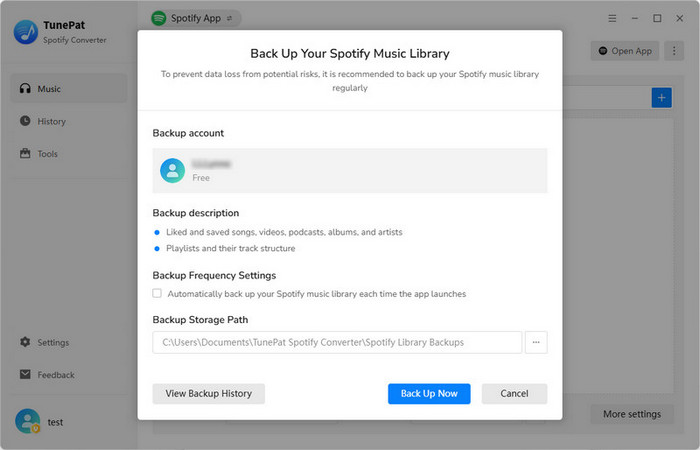
Spotify Music Data Backup & Restore: The latest version adds a "Back Up & Restore Spotify Library" feature to improve data security and manage Spotify data. This is especially useful when switching devices or accounts, helping maintain continuity and avoid losing conversion records or library organization.
Part 2. What We Found in Practice?
On paper, the feature looks comprehensive based on official specs. However, specifications alone don't reflect real-world performance. To see if TunePat remains worth it in 2026, we conducted 5 days of rigorous testing on a Windows 11 PC using the latest software version and a Spotify Premium account. We worked with a mix of playlists, albums, and individual tracks to evaluate both single-track conversions and batch processing under various conditions, documenting every step along the way.
1. Ease of Use
TunePat Spotify Converter is straightforward to use, even for first-timers. The installation package is small (under 10MB) and takes just minutes to set up. The interface is well organized, with audio source switching buttons clearly placed at the top.
During testing, we noticed a short delay when switching to Spotify App mode, as the software needs to launch and connect to the Spotify desktop app, but this takes only a few seconds.
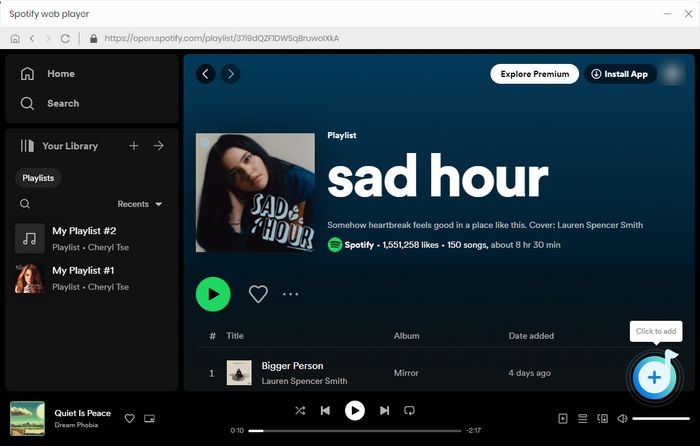
Adding tracks is simple. Just browse Spotify, click the "+" button to load songs, playlists, albums, or podcasts, and start downloading with a few clicks. However, all detected tracks are selected by default, so users who only want specific songs must manually deselect the rest.
2. Customization Options
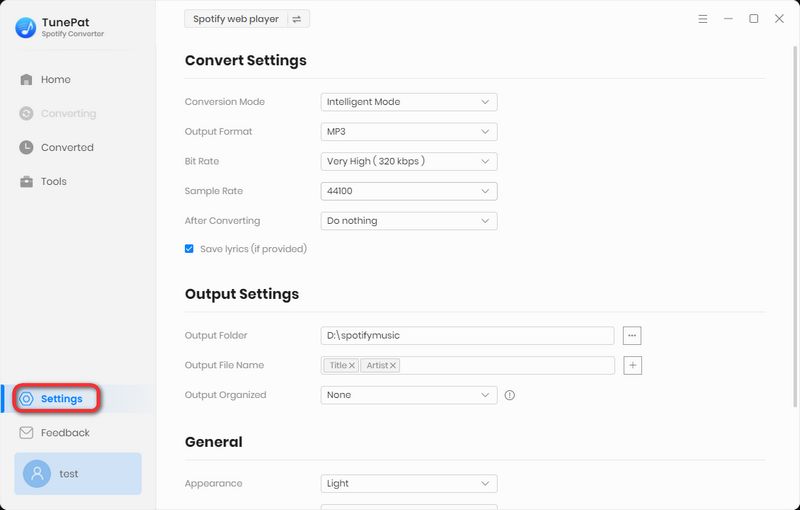
The settings interface offers comprehensive options, from basic settings such as the program's theme color and interface language, to music conversion settings such as conversion mode, output format, bit rate, sample rate, and output folder. You can also edit the output file name, output file organization, and whether to save lyrics. After closing the window, all parameters will be applied automatically. You don't need to modify them every time you use the program.
3. Download Experience
TunePat claims compatibility with both free and paid Spotify accounts. Our primary testing was conducted using a Spotify Premium account, with additional verification performed on a free account. However, we noted that certain tracks cannot be downloaded without signing in; therefore, we recommend logging into your Spotify account as instructed within the application.
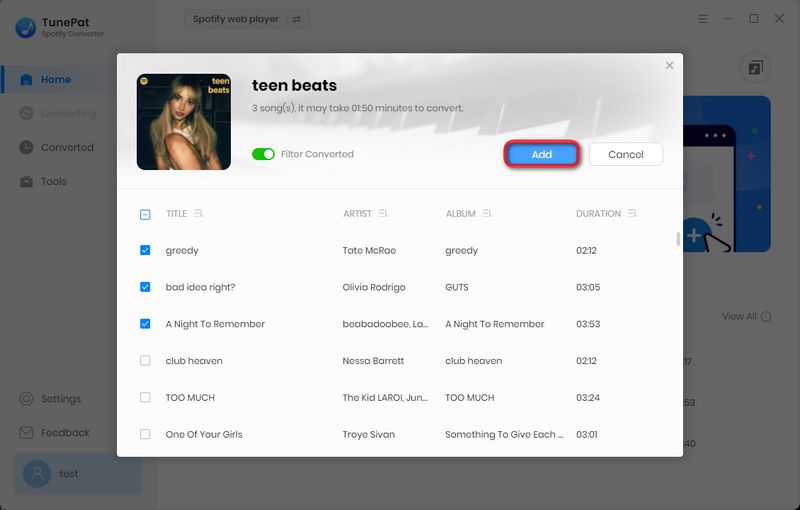
There is a "Filter Converted" button here. After testing, we found that this button's function is to automatically filter out songs that have been converted if you have previously downloaded them using this program, while keeping the download path the same, so they will not be included in this batch download.
4. Conversion Speed & Library Management
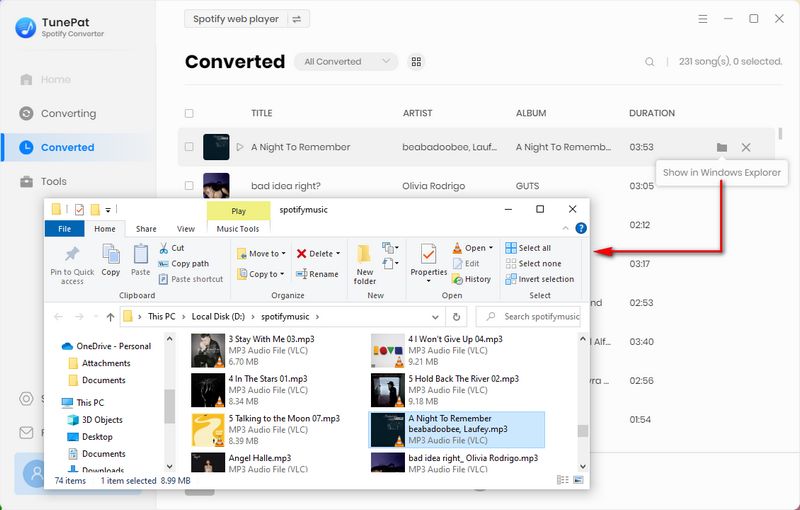
After all downloaded songs have been added, click "Convert" to start the conversion. TunePat claims to offer up to 10x speed, but this is likely achievable with a high-spec computer and a fast internet connection. Overall, the speed is quite fast. When the conversion is complete, the output folder window will pop up. You can check it. Or click the "History" icon on TunePat to check your download history. In the "History" interface, you can also view the album information and the download time of the songs. You can also search for songs by filtering by download time and download format.
5. Audio Quality
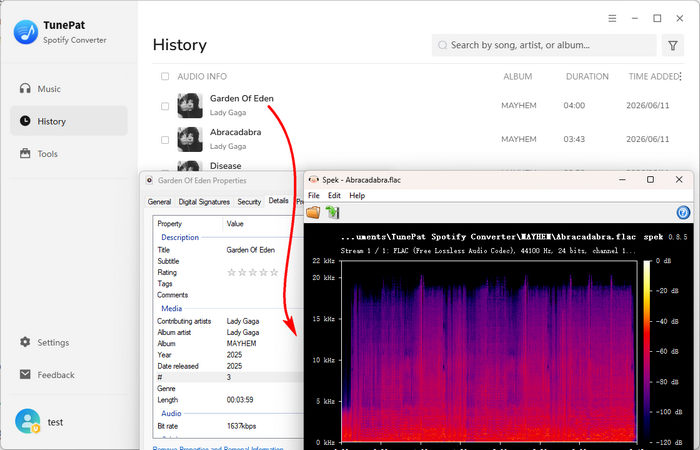
To evaluate audio quality, we followed TunePat's official lossless download instructions to obtain multiple Spotify tracks, then analyzed the output files with spectrum software. The spectrograms showed smooth frequency distribution with no high-frequency cutoffs or compression artifacts, indicating no measurable degradation. Playback tests through headphones and speakers further confirmed that the resulting files were audibly identical to the originals.
6. Music Data Backup & Restore
After finishing the music downloads, we moved on to test a new feature that TunePat added in 2026, Spotify account backup/restore. This button is somewhat hidden; it's located in the upper right corner and appears as three vertical dots. However, once you locate it, the subsequent step-by-step guidance proves very straightforward. With only a few clicks, we can back up or restore a wide range of account data, including liked and saved songs, videos, podcasts, and the exact track structure within each playlist. There is also a convenient checkbox that allows automatic backup every time the app launches.
We were impressed with the backup speed; a free test account with 125 songs took only five seconds to back up. Actual times may vary with library size, but overall the process remains very fast. This is an excellent solution for frequent Spotify switchers who want to easily save their music collections and personal information.
Part 3. Pros and Cons
Pros
Cons
Part 4. Common User Feedback
To make this review as comprehensive and objective as possible, we also examined numerous user reviews on Trustpilot and compared them with our own testing experience. We found that most of the feedback was broadly consistent with our evaluation results, while a small number of reviews differed from our observations. To better understand these discrepancies, we also reached out to the TunePat Support Team for clarification on several commonly mentioned issues. Our findings are summarized below.
Where User Feedback Matches Our Testing
The most frequently mentioned strengths are ease of use, download speed, audio quality, and metadata preservation, which are also the core aspects that matter most for a music downloader. Based on our testing, most of these comments appear well-founded. Audio quality, in particular, stands out as one of its strongest aspects. As shown in our audio analysis above, TunePat can retain the original audio quality well, without the obvious spectral truncation often found in some online download tools. Overall, this part of feedback on Trustpilot is largely consistent with our own experience.
Where Our Experience Differs from User Feedback
The most common complaints relate to customer support response times, software suddenly stopping working, and the limitations of the trial version.
Customer support response timesWe contacted the TunePat Support Team directly and discussed each issue in detail. During the review process, most of our inquiries received helpful responses within 24-48 hours. While response times may vary depending on time zones, we did not encounter the delays mentioned in some reviews.
Unexpected software interruptionsFor reports of the software suddenly becoming unusable, the TunePat Support Team explained that most cases are caused by updates made by streaming music services, which can temporarily affect compatibility. The compatibility issues are typically resolved through subsequent software updates. According to their response, users are encouraged to report these issues when they occur, allowing the development team to investigate and release updates as quickly as possible.
Limitations of the trial versionAs shown in our testing, the trial version currently downloads only the first minute of each track and restricts access to certain features. This can make it difficult for users to fully evaluate the software before purchasing. We shared this concern with the TunePat Support Team, who stated that related improvements have been noted for future consideration. They also mentioned that new users may get free licenses through some promotions, which could be helpful for those who want a more complete evaluation before purchase.
Overall, while some negative reviews raise valid concerns, our experience differed from some of the more critical accounts found on Trustpilot. Based on our communication with the support team and our testing results, we found the team responsive, professional, and willing to listen to user feedback. That said, we believe there is still room for improvement, particularly when it comes to the trial experience.
Summary
Overall, TunePat Spotify Converter delivers stable performance in real-world use, especially for batch music conversions. During testing, it handled format conversion and library organization without major issues. Audio output remained consistent across different test scenarios based on our checks. It is a dependable tool for users who already rely on desktop-based workflows.


 Amazon Music Downloader
 Spotify Music Downloader
 Apple Music Downloader
 Tidal Music Downloader
 YouTube Music Downloader
 Pandora Music Downloader
  Audible Converter
  Video Enhancer AI